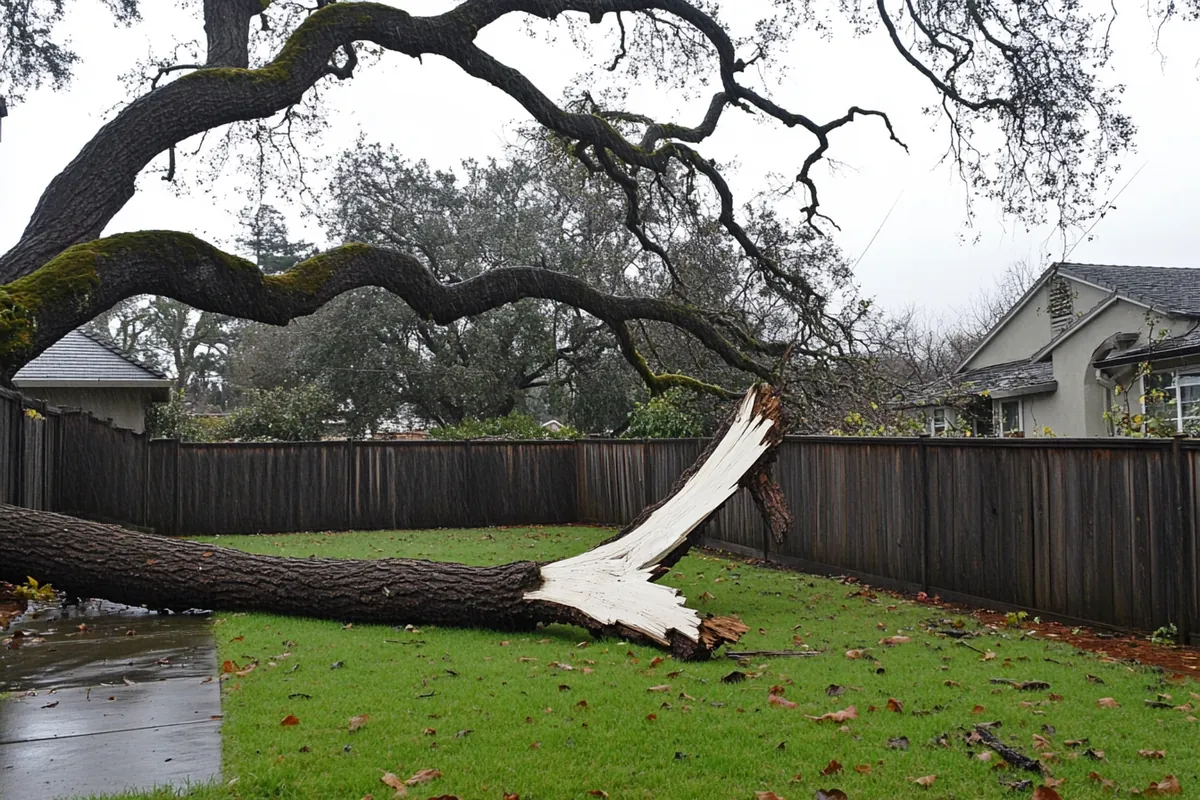
It usually happens at night, deep into a stretch of rain. You hear a crack, then a thud that shakes the house, and in the morning there's a blue oak across the driveway or a pine resting on the roof. Around Petaluma, wind funnels through the gap toward the bay and pushes hard on trees that were fine for decades. In the flat subdivisions of Rohnert Park, it's often a big street-side tree whose roots never spread past the lawn. Either way, the next steps matter. A tree leaning on a roof is still moving weight around, and cutting the wrong piece first can drop it straight through.
This page walks through how to tell what can wait, why trees here fail in wet winters, how we lift a fallen tree off a roof, and what your insurance company usually wants to see. We also cover what you can safely do yourself while you wait, and what's best left alone until a crew arrives. If the tree is still standing but you don't trust it, our tree removal page is the better place to start.
Is It an Emergency or Can It Wait?
Some situations can't wait until Monday. A tree or limb on the roof, especially if rain is getting in. A trunk blocking the only way in or out of the property. A cracked tree still standing but leaning over the house or a neighbor's. Anything touching a power line, which is a call to 911 and PG&E before anyone goes near it, us included. Other damage feels urgent but is safe to schedule: a tree down in an open part of the yard, a broken limb hanging in the crown over a lawn, or a fence flattened by a fallen trunk with nothing else at risk. Keep people and pets away from anything hanging, and don't try to pull a limb down yourself. When you call, tell us what's down, what it's touching and whether there are wires involved, and we'll tell you honestly which group you're in.
Why Trees Here Go Over in Wet Winters
Most storm failures in Sonoma County come down to soil, not just wind. Much of the Santa Rosa Plain and the south county sits on clay that holds water for days. Once it's saturated, the soil around the roots loses its grip, and a tall, full-crowned tree acts like a lever. Arborists call this a root plate failure: the whole tree tips over and lifts a disk of soil and roots with it. The second common type is a stem or limb failure, where wood snaps at an old wound, a decay pocket or a weak fork. Root plate failures tend to hit trees with shallow roots, like those growing over a buried pipe or a cut trench. Limb failures tend to hit trees that went years without pruning. Both get worse when one storm follows another before the ground can dry out.
Lifting a Tree Off Your Roof Without More Damage
The first job is to read the load. We look at where the trunk is resting, which branches are holding it up and which parts are under tension, because a bent limb can spring back hard when it's cut. Then we work from the outside in. Small branches come off first to take weight off the roof. Bigger sections get tied to rigging points in nearby trees, or held by a crane on the largest jobs, so they lift away instead of dropping onto the house. The trunk comes off last. Once it's clear, we cover any open roof area with tarps if your roofer can't get there yet. We chip what we can on site and haul the rest. Throughout the job, we take photos of the damage and the work as it happens, so you have a record of the tree's position before anything was moved.
What Your Insurer Usually Covers
Every policy is different, but a few patterns hold. When a tree falls on your house or another insured structure, like a detached garage or shed, the cost of removing the tree from that structure is usually covered as part of the claim. Removing the rest of the tree from the yard is often covered only up to a debris removal limit, commonly in the range of $500 to $1,000. A tree that falls in the yard and hits nothing usually isn't covered, and neither is a tree that came down because it was dead or rotting for a long time. That's why the photos matter. Before and after pictures, the position of the trunk and a short written note on what we found give your adjuster what they need.
Once the storm has passed, a split limb that held on can often be saved with tree cabling and bracing instead of coming down too.
Frequently Asked Questions
Usually not. Most homeowners policies only pay for tree removal when the tree damaged an insured structure, such as the house, a detached garage or a shed. Some policies also help when a fallen tree blocks your driveway, so it's worth reading yours or asking your agent. A tree that lands in open lawn is normally treated as yard cleanup, which you pay for yourself.
A small limb on the lawn, maybe. A tree resting on a roof, a fence or another tree, no. Fallen trunks and bent branches store a lot of tension, and a single cut can make a section roll or spring back with real force. Add wet ground, a chainsaw and a ladder, and that's how most storm injuries happen. Leave anything that's under load, off the ground or near a wire to a trained crew.
Rarely, if it's a mature tree. Once the root plate has lifted, the roots on one side are torn and the tree has lost most of its anchor. Pulling it back upright doesn't repair that, and it usually fails again in the next storm. Young trees with a small root ball are the exception and can sometimes be straightened and staked. For a big tree that has tipped, removal is almost always the safer call.