Some trees are worth keeping even with a flaw. A big valley oak shading a Windsor backyard might have two trunks growing from one fork, with a crack starting where they meet. A walnut in Cotati might carry one long limb that bounces too much in the wind. Taking the tree down solves the problem, but it also takes away decades of shade, privacy and value. Cabling and bracing is the middle option. A steel cable high in the crown limits how far the trunks or limbs can move apart, and a threaded rod through a split fork holds the wood together. Done right, the tree keeps its shape and nobody notices the hardware unless they look for it.
Below we explain which trees are good candidates, how cables and rods actually work, how we install them and what upkeep they need over the years. You'll also see the signs that a tree is past the point where hardware can help, because cabling the wrong tree only delays the problem. Cabling usually goes hand in hand with tree trimming and pruning, since taking weight off the ends of the limbs is half the fix.
Trees That Are Good Candidates
The most common reason is a weak fork. When two trunks of similar size grow up from one point, the bark can get pinched between them as they thicken. That pinched bark, called included bark, keeps the wood from bonding, so the joint stays weak no matter how big the tree gets. Other good candidates: a long, heavy limb over a roof or patio, a tree with an old crack that hasn't opened further, and a valuable tree that lost part of its crown in a storm. Cabling isn't a cure for everything. A tree with decay at the base, a failing root system or a crack that's already moving is past what hardware can hold. In those cases we'll tell you plainly that removal is the safer route.
How Cables and Rods Do the Work
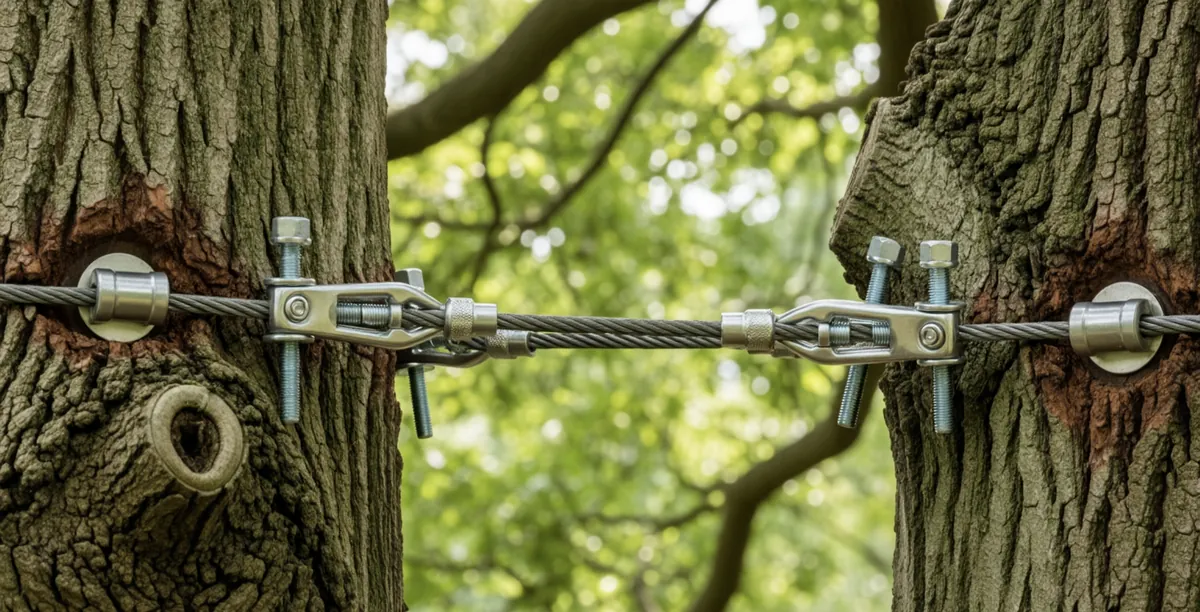
Cables and rods do two different jobs. A cable is installed high in the tree, typically about two-thirds of the way up from the weak union toward the ends of the limbs. Up there, it doesn't take much force to stop the two sides from pulling apart in a gust, so the fork below doesn't have to carry all that strain. Static cables are steel strand that stays snug. Dynamic systems use a synthetic rope with some stretch, letting the limbs flex a little while still catching them if they swing too far. Bracing rods work low, at or just above the fork. A threaded steel rod runs straight through both stems and is bolted on each side, so a split can't spread. Most trees that need a rod also get a cable, because the two work as a team.
How We Install Them
First, we check the whole tree, not just the weak spot, because hardware only makes sense on a tree that's sound everywhere else. We usually start with a light pruning to take weight off the limbs we're supporting. Then a climber drills small holes through the wood at the anchor points and sets the hardware: through-bolts or eye bolts for steel cable, or wraps for a synthetic system. The cable is tensioned so it's snug in calm air without pulling the limbs together. For a split fork, the rod goes in below the crack and gets washers and nuts on both ends. A single cable job on one tree usually fits in a morning. On the way out, we note exactly what went in and where, so the next inspection has something to check against.
Keeping an Eye on It Over the Years
A support system is not install-and-forget. Trees keep growing, and hardware that fit well today can get too tight or too loose in a few seasons. Cabled trees should be looked at on a regular schedule, and after any big windstorm. We check for wear where the cable meets the wood, bark starting to swallow a bolt or wrap, a cable that's gone slack, and any change in the crack the system is protecting. Synthetic systems carry a manufacturer's service life and need replacing sooner than steel. If a tree has improved, with the fork thickening and the crack staying closed, the system just stays in place. If it's getting worse, that's the time to talk about other options before the tree makes the decision for you.
If the weak fork came with thin leaves or dieback in the crown, a tree health care visit can tell you whether the tree is strong enough to support.
Frequently Asked Questions
Steel cable systems can stay in a tree for many years when they're inspected and adjusted as the tree grows. Synthetic dynamic systems wear faster and get replaced on the manufacturer's schedule. In both cases, the lifespan depends on the tree. A fast-growing tree can outgrow its hardware sooner, which is why regular checkups matter more than the material.
The holes we drill are small, and a healthy tree seals around them the same way it closes over a pruning cut. The bigger risk is a system that's never checked. A cable wrapped tight around a limb can girdle it over time, and a bolt can work loose. That's why we use through-hardware or approved wraps and come back to look at it. Properly placed, the support does far more good than the hardware does harm.
Often, yes, for a healthy tree with one weak spot. A mature oak or redwood takes a lifetime to replace, and it shades the house, adds value to the property and screens the neighbors. Cabling keeps all of that at much less than a large removal plus replanting usually runs. It's not worth it on a tree with decay at the base or a crack that's already spreading.